
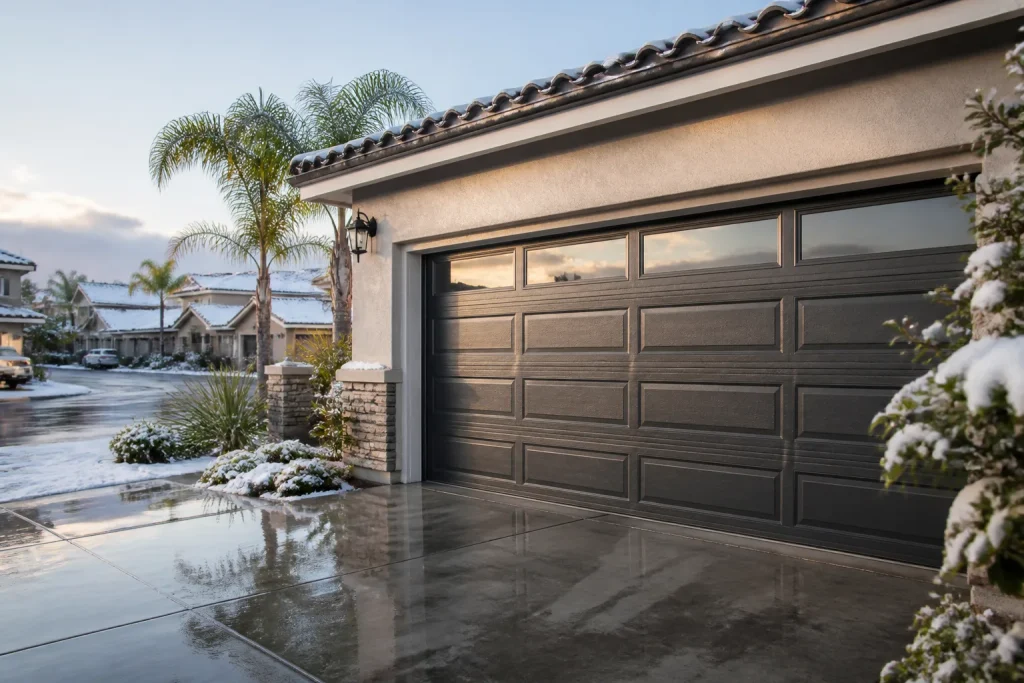
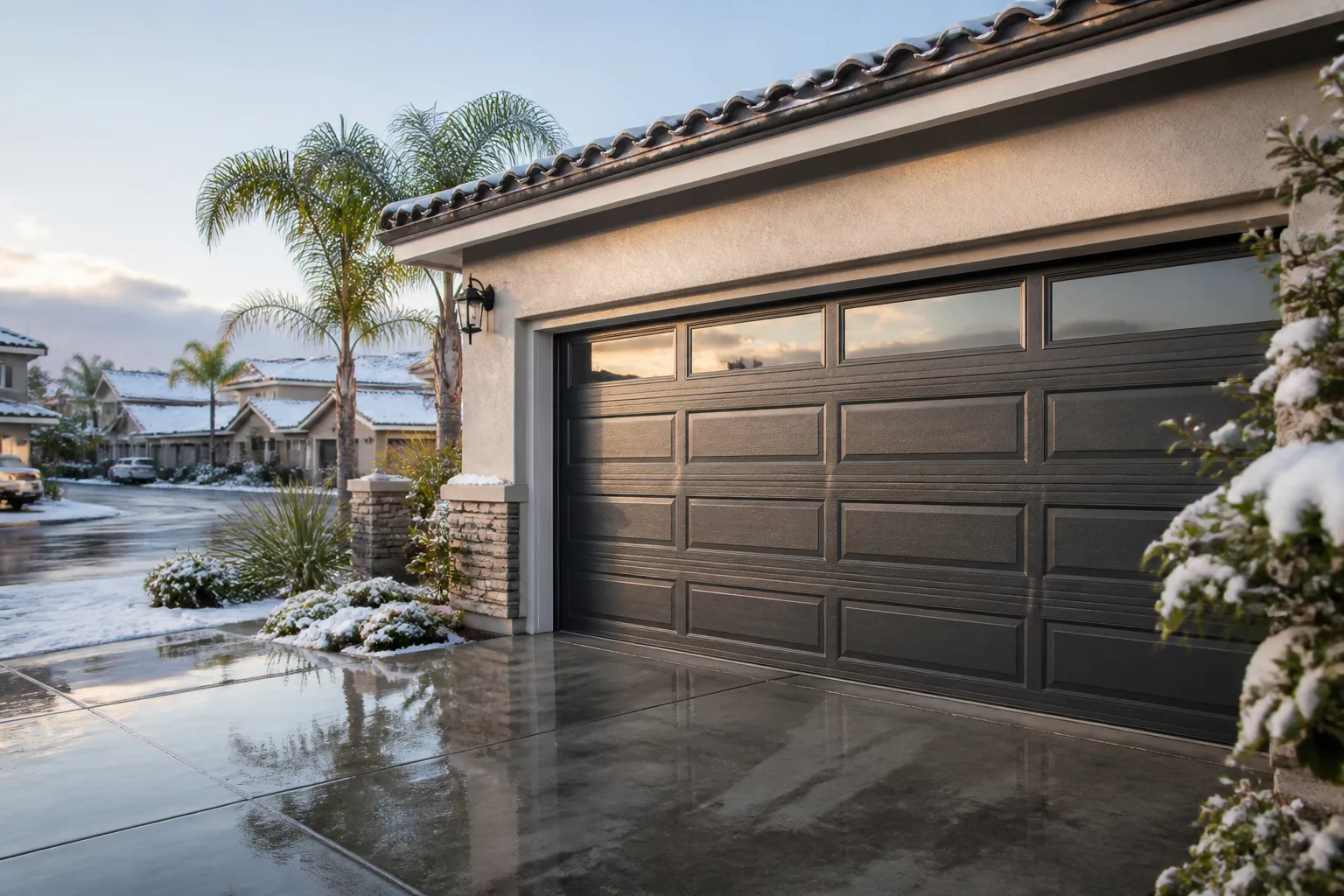
Preparing Your Home’s Garage Door for Winter in Los Angeles
Garage door winter preparation in Los Angeles focuses on moisture protection, metal contraction from 30-degree temperature swings, and wind-stress hardware checks rather than freeze prevention. Most LA homeowners need to inspect weatherstripping, lubricate moving parts before fall temperatures tighten tolerances, verify auto-reverse sensor function in cooler air, and check track mounting hardware for looseness after Santa Ana wind season. If you’d rather have a technician handle this, call Summit Garage Door Los Angeles at (877) 416-3411 for a free estimate.
Here’s the thing most people in Los Angeles get wrong about winter garage door prep. They read a guide written for Minneapolis or Denver, see advice about insulating against subzero temperatures, and figure none of it applies. They’re half right. We don’t need freeze protection. But the narrow temperature swings between November and February, combined with marine layer moisture and Santa Ana winds, create a specific wear pattern that’s actually harder on hardware than steady cold. Over nine years of working exclusively on garage doors across Los Angeles, we’ve seen more spring failures, sensor misalignments, and bottom seal rot in January than in any summer month. The maintenance you skipped in August doesn’t forgive you in December.
Why LA’s Coastal Moisture Destroys Weatherstripping Faster Than Cold
The marine layer rolls in heavy from October through March, and that persistent damp air finds every gap in your garage door’s perimeter seal. We’ve replaced bottom seals in Venice, Marina del Rey, and San Pedro that looked fine in September but were cracked and porous by February. The salt content in coastal air accelerates rubber degradation beyond what inland homeowners experience.
Here’s what to check before the rainy season starts:
- Close the door and look for daylight underneath. Any visible gap means water, dust, and pests enter freely.
- Feel along the bottom seal with your hand. If it’s stiff, cracked, or compressed flat, it’s done.
- Inspect the vinyl or rubber weatherstripping on the door sides and top. LA’s UV exposure in summer hardens it; winter moisture then causes splitting.
- Check the threshold seal on the floor itself. Concrete expansion from summer heat often creates gaps the seal no longer bridges.
We stock and service replacement seals for Wayne Dalton, Craftsman, and Raynor systems, and the fit varies significantly by model year. A generic seal from a hardware store often leaves a 3/8-inch gap that defeats the purpose.
The Fall Lubrication Window Most Homeowners Miss
Metal contracts when temperatures drop. In Los Angeles, that 30-degree swing between a 75-degree afternoon and a 45-degree morning is enough to tighten tolerances on springs, hinges, and rollers that were already marginal. If you lubricate in summer, the heat thins the product and it migrates away from contact points. If you wait until January, you’re fighting contracted metal with dry, binding surfaces.
Late October through mid-November is the sweet spot. Here’s what we do on every maintenance call:
- Apply lithium-based grease to torsion or extension springs. Never use WD-40; it attracts grit and evaporates.
- Work silicone lubricant into roller bearings and hinge pivot points.
- Lightly coat the opener rail on chain-drive LiftMaster and Craftsman units, not the chain itself.
- Wipe excess completely. Accumulation traps dust and forms abrasive paste.
A note on safety: garage door springs hold enormous tension. We check spring balance and wind every time we lubricate, and we don’t recommend homeowners adjust spring tension themselves. A slipping winding bar causes serious injury.
Santa Ana Wind Prep: Checking Track Hardware Before It Fails
The Santa Ana wind season runs roughly October through January, and those sustained 40-plus mph gusts vibrate everything loose. We’ve responded to emergency calls in the Hollywood Hills, Pasadena, and the Valley where track mounting bolts had backed out so far the door jumped the roller path. One homeowner in Los Feliz heard a bang at 2 a.m. and found her door hanging at a 15-degree angle.
Inspect these points with the door closed:
- Track mounting brackets where they attach to the wall framing. Look for elongated bolt holes or fresh wall dust below the bracket.
- Top fixture bolts that hold the upper rollers. These take the most wind stress.
- Flag bracket connections between the vertical and horizontal track sections.
- Opener arm attachment to the door. A loose arm strains the motor and can strip the carriage.
We pulled one out of a garage over in Silver Lake last month where the previous installer had used 1-inch lag bolts into drywall anchors. The wind didn’t create the problem; it revealed it. Proper track hardware needs to bite into solid framing.
Why Your Auto-Reverse Test From August Might Fail in December
Photo-eye sensors behave differently in cooler, denser air. The infrared beam can scatter more, and condensation on the lens creates false obstruction readings. A door that reversed reliably in summer may refuse to close on a December morning, or worse, it may not reverse when it should.
Test this properly:
- Clean both sensor lenses with a dry cloth. Moisture residue fogs them.
- Verify alignment. The LED indicators on most LiftMaster and Genie units glow steady when aligned; flickering means they’re on the edge of failure.
- Run the door down and interrupt the beam with a solid object. It must reverse immediately.
- Place a 2×4 flat on the floor centerline. The door must reverse on contact. If it doesn’t, the close-force sensitivity needs adjustment.
Cooler temperatures increase lubricant viscosity and spring tension, which changes the force the opener applies. A force setting that was borderline in summer becomes non-compliant in winter. This isn’t a sensor problem; it’s a system interaction problem that requires recalibration.
The Balance Check That Extends Spring Life
This is the one item most Los Angeles homeowners skip entirely, and it’s the most consequential. Garage door springs are rated for a specific number of open-close cycles, typically 10,000 for standard springs. But an unbalanced door cycles the spring unevenly, cutting that lifespan by 30 to 50 percent.
Summer heat accelerates the problem. Metal expands, the door warps slightly, and the opener compensates with extra force. By fall, the spring has taken uneven set. When cooler temperatures contract everything, the imbalance becomes mechanical stress.
Test balance with the opener disconnected:
- Manually lift the door to waist height and release.
- A balanced door stays put or drifts slowly. If it races up or crashes down, the spring tension is wrong.
- Check for binding or sticking at any point in the travel. Jerky motion indicates track misalignment or worn rollers adding load.
Spring recalibration in fall, before the contraction stress of winter, typically adds two to three years of service life. We’ve measured this across hundreds of doors in Los Angeles. The homeowners who schedule fall maintenance replace springs half as often.
When to Call a Pro
Some of these checks are straightforward. Others involve components that can cause serious injury if handled incorrectly. We don’t recommend DIY spring adjustment, track realignment on a loaded door, or opener force calibration without proper tools. If your door fails the balance test, makes grinding noises, or has visible hardware damage, that’s the point to bring in a technician.
Summit Garage Door Los Angeles handles garage door repair in Westmont and throughout the LA area, including garage door installation in Westmont and garage door opener service in Westmont. Michael Reyes personally oversees every job as both owner and lead technician.
The Bottom Line
Los Angeles winter garage door prep is a distinct checklist. Coastal moisture attacks seals. Temperature swings contract metal and change sensor behavior. Santa Ana winds exploit every loose fastener. And the spring balance degradation that started in summer becomes critical when cooler temperatures remove all the tolerance.
The key takeaways:
- Inspect and replace weatherstripping before marine layer season peaks
- Lubricate in fall, before temperature contraction tightens clearances
- Check track hardware for wind-vibration looseness
- Retest auto-reverse function in cooler conditions
- Verify door balance and schedule spring recalibration if needed
If you’re in Los Angeles and want a professional assessment, Summit Garage Door Los Angeles offers free estimates. Michael Reyes will inspect your system personally and give you straight answers on what’s needed now versus what can wait. Call (877) 416-3411 to schedule.
Frequently Asked Questions
Yes. While LA doesn’t face freezing temperatures, the 30-degree overnight swings between November and February contract metal hardware, marine layer moisture degrades seals, and Santa Ana winds stress track mounting. These factors cause more winter service calls than most homeowners expect. Call (877) 416-3411 for a free inspection if you’re unsure about your door’s condition.
A standard maintenance and inspection visit typically runs $89–$149 depending on door size and accessibility. If we find issues during the inspection, we’ll explain exactly what’s needed and provide upfront pricing before any additional work. Estimates are always free, so call (877) 416-3411 for exact pricing for your specific setup.
You can apply lubricant to accessible hinges and rollers safely. However, springs hold lethal tension and should not be adjusted by homeowners. We also recommend professional lubrication because the correct product selection and application points vary by brand, age, and configuration. If your door is a LiftMaster, Craftsman, or Raynor system, we can match the proper maintenance protocol.
Warning signs include visible gaps in the coil, a door that feels heavy to lift manually, uneven opening, or loud popping sounds during operation. Springs that have cycled through multiple Los Angeles summers without balance checks are often near failure. We recommend professional evaluation, as a broken spring can damage the door or cause injury. Call (877) 416-3411 for a same-day assessment.
Written by Michael Reyes, Owner & Lead Technician at Summit Garage Door Los Angeles, serving Los Angeles since 2017.
Need Garage Door Help?
Call Summit Garage Door Los Angeles — licensed & insured, available 24/7 in Los Angeles.
(877) 416-3411