
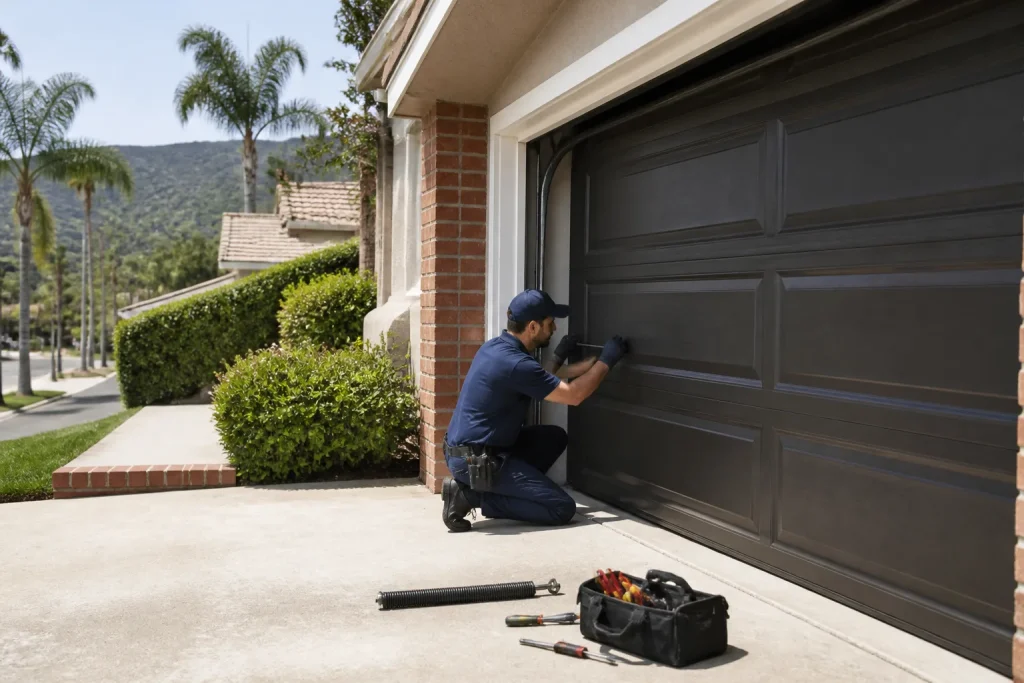
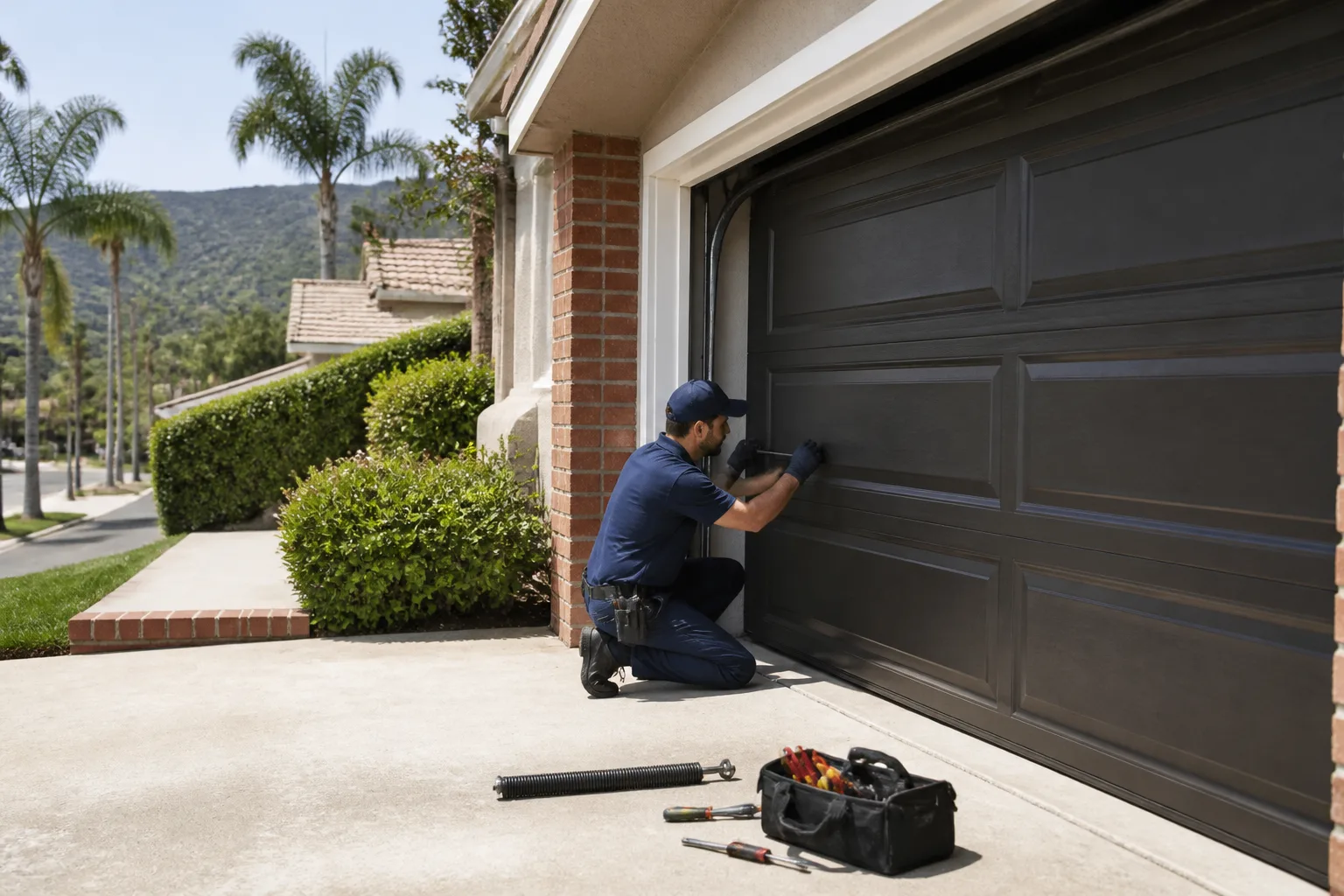
5 Mistakes to Avoid With Garage Door Parts
The five costliest garage door parts mistakes come down to installation sequence, not part selection. Most homeowners buy the correct spring or roller and still watch it fail months later because paired components were worn, the door wasn’t rebalanced, or the wrong lubricant turned dust into grinding paste. If you’d rather have a technician handle it, Summit Garage Door Los Angeles offers free estimates — call (877) 416-3411.
We pulled into a garage over in Koreatown last month where the homeowner had installed brand new torsion springs himself. Six weeks later, one snapped. The springs were fine. The cable drums they’d been installed onto were grooved and out of round from 14 years of use. That’s the pattern we see most: right part, wrong conditions, premature failure.
1. Buying Parts by Price Instead of Gauge
The $12 roller set at the hardware store looks identical to the $28 set online. Same nylon wheel, same stem, same packaging photo. What you can’t see is the stem gauge, the bearing seal rating, and how many cycles the wheel is rated for.
Here’s the math that matters in Los Angeles. A standard 10-ball bearing roller with a 7-gauge stem lasts roughly 50,000 cycles. A bargain 13-gauge stem roller with a sleeve bearing might last 10,000. At four cycles per day, that’s 34 months versus 6.8 months. You’re paying labor either way — ours or yours — so the $16 savings costs you a second repair inside of two years.
We see this constantly on Craftsman and Raynor systems where the original spec was a 10-ball bearing, and the replacement was a visual match with half the load capacity. The door gets heavier to lift. The opener strains. Six months later we’re replacing the opener sprocket too.
What to do instead:
- Match the stem gauge to the door weight — 2-inch doors need 7-gauge minimum
- Check for a ball bearing count, not just “bearing” on the label
- Buy once on rollers; they’re the cheapest part to upgrade and the most labor to replace
2. Skipping the Door Balance Test After Spring or Cable Work
A balanced door stays put at 2 feet off the ground. Not slowly drifts. Stays put. This isn’t a preference — it’s the test that tells you whether the spring tension matches the door weight across the full travel.
We test this on every spring job in Los Angeles, and roughly one in three DIY or competitor installs we follow up on fails it. The door either rockets up from the bottom or sinks from the top. Both conditions burn out openers. A LiftMaster belt drive rated for 15 years can fail in 3 when it’s fighting an unbalanced door twice daily.
The 2-foot test is simple but specific. Disconnect the opener. Lift the door manually to waist height. Let go. If it moves more than an inch in either direction, the spring tension is off. If it feels heavy to lift from the floor or won’t stay down without force, the tension is wrong for the door weight.
What “balanced” actually means: the springs store enough potential energy to cancel the door’s weight at every position. Not most positions. Every position. An unbalanced door puts cyclic load on the opener, the hinges, and the top section where the opener attaches. We’ve replaced top sections in Westmont and Baldwin Park where the fatigue cracked the steel right at the opener bracket.
3. Using Hardware Store Bolts as Track Substitutes
Track bolts for garage doors are Grade 5, fine-thread, with a shoulder that centers the bracket. The 5/16-inch lag bolts at the hardware store are coarse-thread, designed for wood-to-wood fastening, with no shear rating that matches door vibration.
The difference matters under repeated cycling. A garage door in Los Angeles opens and closes 1,400+ times yearly. Coarse threads loosen in metal. Fine threads don’t. We’ve found track brackets held by lags that backed out half an inch, letting the track spread and the rollers pop. One was on a Wayne Dalton system in View Park where the homeowner had “fixed” a noisy door with a hardware store bolt kit.
The specific mismatch:
- Track bolts: 5/16-24 UNF thread, Grade 5 minimum, 1-inch shoulder for bracket alignment
- Hardware store lag: 5/16-16 UNC, no shear spec, tapered point that doesn’t center
- Vibration frequency: roughly 3 Hz per open/close cycle, 4,200 Hz yearly
Buy track bolts from a garage door supplier. They’re $0.40 each. The alternative is a door off its track, which in our experience always happens at inconvenient hours.
4. Over-Lubricating Rollers and Hinges, Under-Lubricating Springs
These parts need opposite treatment, and most homeowners get both wrong.
Rollers and hinges need light lubrication on the pivot points only. Excess lube attracts dust from Los Angeles garages — concrete dust, pollen, brake dust from parked cars — and forms an abrasive paste. We’ve disassembled hinges that ground themselves oval from this paste. The owner thought more lube was better protection.
Springs need generous, regular lubrication. Torsion springs unwind and rewind against themselves 1,400 times yearly. Without lubricant, the coils micro-weld and snap. We lubricate springs on every maintenance call with a lithium-based spray, never WD-40 (it evaporates) and never grease (it traps grit).
The exact split:
- Rollers: one drop on the bearing, wipe excess immediately
- Hinges: pin only, work the door to distribute, wipe the surface clean
- Springs: full coat, top to bottom, every 3 months in Los Angeles climate
The climate matters here. Our dry summers and occasional Santa Ana winds move more dust into garages than coastal cities. That dust plus over-lube equals accelerated wear.
5. Replacing Only the Broken Spring on a Two-Spring System
This is the most predictable mistake we encounter. The door has two springs. One breaks. The homeowner replaces one. Four months later, we’re back for the other one — often on a weekend, often with a car trapped inside.
Torsion springs fatigue predictably. Same material, same cycles, same stress. When one breaks, the other has identical cycle count and identical metal fatigue. It’s not “still good.” It’s “scheduled to fail.” In our 9 years, we’ve seen maybe a dozen cases where the surviving spring lasted more than 8 months after its pair broke. The average is 10 to 16 weeks.
The economics are straightforward. One spring call: spring cost plus labor. Two spring calls: double the labor, double the trip charge, plus whatever damage the second failure causes when it snaps and the door slams uncontrolled. We quote both springs every time. Some homeowners decline. We keep their record, and we know roughly when we’ll hear from them again.
Related services in Los Angeles: Garage Door Repair in Westmont and Garage Door Installation in Westmont for full system evaluations.
When to Call a Pro
Torsion spring work is genuinely dangerous. The stored energy in a standard 16-foot door spring can cause serious injury or worse. Cable work under tension carries similar risk. If your repair involves winding springs, releasing cable tension, or working on an open door above head height, that’s the point to step back.
We handle these jobs daily across Los Angeles. Michael Reyes, our owner and lead technician, personally oversees spring and cable work. Not a subcontractor. Not a dispatcher sending whoever’s available. The person accountable for the business is the one at your door.
For opener issues, roller replacement, or track realignment, experienced homeowners can sometimes self-service. For anything under tension, the safety case for professional work is strong.
The Bottom Line
The right part installed wrong fails faster than the wrong part installed right. Gauge matching, balance testing, correct fasteners, differentiated lubrication, and paired spring replacement — these five practices separate a repair that lasts from one that repeats. The common thread is systems thinking: garage door parts work as an integrated assembly, not isolated components.
If you’re in Los Angeles and want a technician who’ll check the cable drums before installing your springs, test balance before leaving, and tell you honestly whether both springs need replacement, Summit Garage Door Los Angeles offers free estimates. Call (877) 416-3411. We’ve got 180 verified reviews from neighbors who’ve made that call.
Frequently Asked Questions
Quality 10-ball bearing rollers last 10 to 15 years under normal use in Los Angeles. Bargain rollers with sleeve bearings often fail in 2 to 3 years. The difference is stem gauge and bearing quality, not visible similarity. Call (877) 416-3411 for a free roller inspection — estimates are free.
You can, but we don’t recommend it. Paired springs share identical fatigue. When one breaks, the other typically fails within 2 to 6 months. Replacing both together avoids a second service call and potential damage from an uncontrolled door drop. Call (877) 416-3411 for exact pricing on your door size — estimates are free.
An unbalanced door overloads the opener, strains hinges, and can crack the top steel section. Test by disconnecting the opener and lifting to 2 feet — the door should stay within 1 inch of that position. If it drifts, the spring tension needs adjustment. This is not a DIY adjustment; the stored spring energy is dangerous. Call (877) 416-3411 for same-day balancing in Los Angeles.
Lubricate springs every 3 months with lithium-based spray. Lubricate rollers and hinges annually with one drop per pivot point, wiping all excess. Never use WD-40 on springs — it evaporates and leaves metal unprotected. Never over-lubricate rollers; excess attracts dust that forms grinding paste. For maintenance scheduling in Los Angeles, call (877) 416-3411.
Written by Michael Reyes, Owner & Lead Technician at Summit Garage Door Los Angeles, serving Los Angeles since 2017.
Need Garage Door Help?
Call Summit Garage Door Los Angeles — licensed & insured, available 24/7 in Los Angeles.
(877) 416-3411